
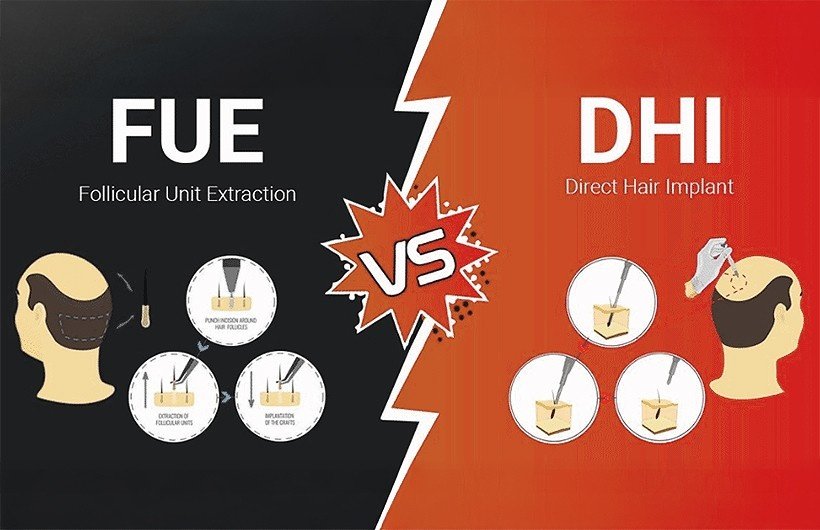
FUE vs DHI Hair Transplant: Which Technique Is Right for You?
FUE vs DHI Hair Transplant is one of the first questions almost every patient brings to their consultation once they’ve started researching hair restoration. At our Hair Transplant Clinic in Ahmedabad, Dr. Stuti Bajaj offers both techniques — and one of the first things she does is help patients understand that neither one is a universal “winner.” The right choice depends on your hair loss pattern, donor hair availability, and what you’re trying to achieve. If you’re still weighing whether a transplant is worth it at all, our guides on choosing the right hair transplant specialist and hair transplant cost in Ahmedabad are good starting points.
This guide breaks down how each technique works, where they differ, and how to think about which one fits your case.
What Is FUE (Follicular Unit Extraction)?
FUE is the technique most hair transplants are built on today. Individual hair follicles are extracted one at a time from the donor area (usually the back or sides of the scalp) using a tiny punch tool. Small recipient sites are then created in the thinning area, and the extracted grafts are implanted using forceps.
Key characteristics:
- No linear scar — just tiny, dot-like marks that are easily hidden by surrounding hair
- Works well for both smaller touch-ups and larger sessions requiring a high graft count
- Well-established technique with a long track record, backed by ISHRS clinical guidelines
What Is DHI (Direct Hair Implantation)?
DHI is built on the same extraction process as FUE — the difference lies entirely in how the grafts are implanted. Instead of creating recipient sites first and then placing the grafts, DHI uses a specialised pen-like tool (often called a Choi implanter) that creates the site and implants the graft in a single motion.
Key characteristics:
- Allows for precise control over the angle, depth, and direction of each graft
- Often preferred for hairline design, where natural direction matters most
- Typically suited to smaller-to-moderate graft sessions, since the implantation process is more time-intensive per graft
It’s worth understanding that DHI isn’t a separate surgery from FUE — it’s a variation of it. The extraction step is identical; only the implantation method changes.
FUE vs DHI Hair Transplant: 7 Key Differences
| # | Factor | FUE | DHI |
| 1 | Extraction method | Individual follicle punch extraction | Same as FUE |
| 2 | Implantation method | Recipient sites created first, grafts placed after | Graft implanted directly with a specialised pen |
| 3 | Scarring | Minimal, dot-like marks | Minimal, dot-like marks |
| 4 | Graft handling time | Shorter time outside the body | Slightly longer, since each graft is loaded individually |
| 5 | Best suited for | Larger sessions, broader coverage | Precision hairline design, smaller/moderate sessions |
| 6 | Recovery | Quick, no stitches | Quick, no stitches |
| 7 | Session duration | Can be shorter for high graft counts | Often longer due to the implantation process |
So Which One Actually Grows Better Hair?
This is the question patients care about most — and the honest answer is that graft survival depends far more on the surgeon’s skill, how quickly grafts are handled, and the quality of the donor area than on which acronym is used. Both techniques extract follicles the same way, and both can deliver excellent, natural-looking results in the right hands. Where they genuinely differ is in how much control they offer during implantation and how that control gets used for different goals.
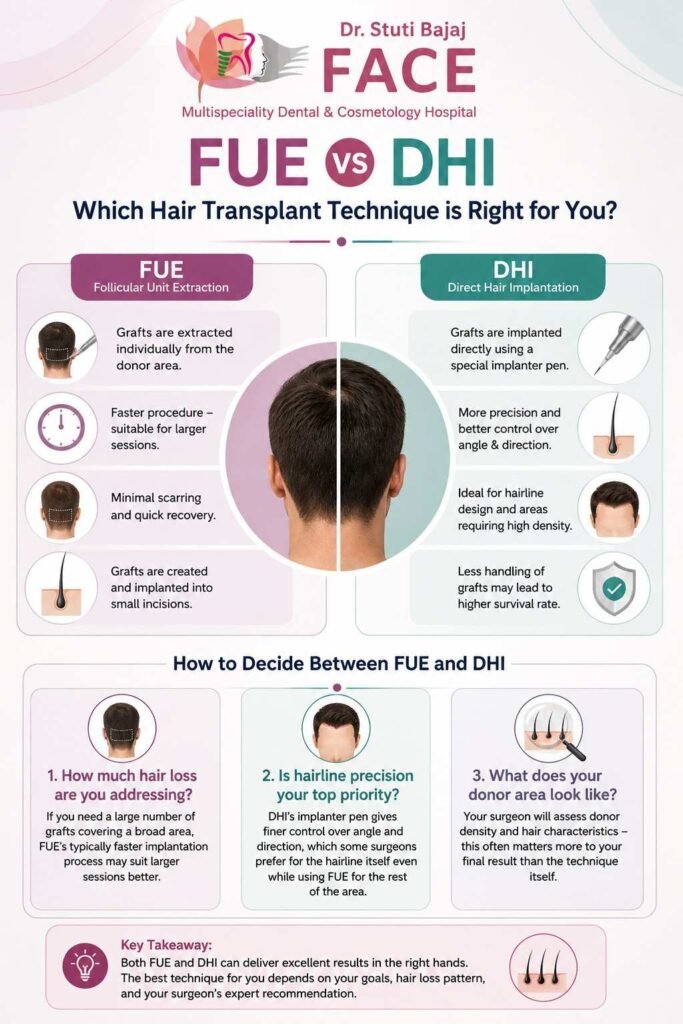
How to Decide Between FUE and DHI Hair Transplant
A few practical questions to bring to your consultation:
How much hair loss are you addressing?
If you need many grafts covering a broad area, FUE’s typically faster implantation process may suit larger sessions better.
Is hairline precision your top priority?
DHI’s implanter pen gives finer control over angle and direction, which some surgeons prefer for the hairline itself even while using FUE for the rest of the area.
What does your donor area look like?
Your surgeon will assess donor density and hair characteristics — this often matters more to your result than the technique itself.
Many surgeons, including Dr. Bajaj, will combine approaches within a single session — using DHI-style precision for the hairline and standard FUE implantation for density behind it — rather than treating it as an either/or choice. And if you’re not yet sure a transplant (versus a non-surgical option) is the right call at all, our comparison of hair transplant vs PRP therapy covers that decision separately.
Ready to Explore Your Options?
Whether FUE, DHI, or a combination of both is right for you depends on your hair loss pattern and goals. Dr. Stuti Bajaj can walk you through the FUE vs DHI Hair Transplant decision at your consultation. Book a consultation or learn more on our Hair Transplant treatment page.
Meet Dr. Stuti Bajaj | Dental & Skin Specialist in Ahmedabad
At Face Multispeciality Dental & Cosmetology Hospital, we combine clinical expertise with modern treatment options to provide personalized care for skin, hair, dental, and cosmetic concerns
Frequently Asked Questions
Is DHI more expensive than FUE?
DHI can cost more per graft in some clinics because the implantation process takes longer, though pricing structures vary — this is best confirmed at your consultation.
Does DHI hurt less than FUE?
Both are done under local anaesthesia, so discomfort during the procedure is minimal either way. Post-procedure sensitivity is similar for both techniques.
Can I switch from FUE to DHI partway through treatment?
Since DHI is a variation of FUE rather than a completely different procedure, many clinics combine both approaches within the same session based on what different areas of the scalp need.
How do I know how many grafts I’ll need?
This depends on the extent of your hair loss and the density you’re aiming for — an in-person scalp evaluation is the only reliable way to estimate this.
Disclaimer: This article is for general informational purposes only and is not a substitute for professional medical advice, diagnosis, or treatment. The right hair transplant technique for you can only be determined after an in-person scalp evaluation with a qualified specialist.
